
For some time now, we find on the market a range of plastic bags so-called ecological compostable, biodegradable, etc.. The chemical compositions are increasing in this area and yes even more sayings! Here is a short guide to help you in choosing your shopping bag, but first, some definitions!
Biodegradation: " Decomposition of a product by the action of microorganisms (bacteria, fungi, etc.). in the environment. "(Le Petit Larousse Illustre, 2005)
Compost: " fermented blend of organic and inorganic residues used to enrich farmlands . "(Le Petit Larousse Illustre, 2005)
Polyethylene: "Variety plastic obtained by polymerization of ethylene (gaseous hydrocarbon colorless). " (mediadico.com)
Recycling " [...] recovery of certain items from the waste. Paper and cardboard, plastics, metals and glass are sorted and processed industrially before being reintroduced in the cycle of production of objects of consumption. (Montréal)

compostable bags
These are made from cornstarch or potato and do not contain polyethylene ; they can be mixed with compost for vegetable gardens.
We however can not be recycled because the fact that they are chemically designed to deteriorate rapidly contaminates the quality of recycled plastic and thus reduce its economic value.

biodegradable bags (or oxo-biodegradable)
They are made of polyethylene in which introduced an additive that can degrade in a few weeks under the action heat and oxidizing chemicals in landfills. They take between 90 and 120 to deteriorate.
should not be composted because they may contain unwanted toxic molecules (petroleum) in a soil for growing food.
As for compostable bags, chemical composition of these bags is such that they are not recyclable because they cause accelerated aging of recycled plastic. An exception exists, however: brand bags PPE can be recycled through additive TDPA (Totally Degradable Plastic Additive).
In summary , the choice of the bag depends on the use you make of it.
For a bag of trash , it would be best to opt for compostable bag since it is not toxic and that its decomposition is relatively rapid. Many landfills have their drainage system blocked by plastic bags that are at least 100 years to decompose; These blockages can sometimes cause flooding and therefore spills leaching (garbage juice), highly toxic liquid.
For recycling, if you can not use a tray, choose the traditional bag or oxo-biodegradable PPE they are recyclable.
For composting, if you do not have your own compost and municipal collection is not in tanks, use of compostable bags as they are nontoxic and can be mixed safely to earth culture.
Be familiar with some of the laws in your area for the collection service and the types of bags accepted.

course, the best plastic bag is one you will not use. traditional bags and biodegradable contain petroleum products, with manufacturing (energy) and the delivery of all plastic bags, compostable, biodegradable and traditional alike, depend on oil. Moreover, in a global context where arable land is increasingly reduced, but where the population increases, we can question the fact of devoting large areas of arable land to produce monocultures of corn or potatoes that does will not on plates but people in the production of biodegradable bags. Not to mention that monocultures contribute to the deterioration of biodiversity ...
Finally, by opting for reusable bags and reducing the amount of materials that are thrown in the garbage, we reduce our oil dependence and our carbon footprint.
Photo credits:
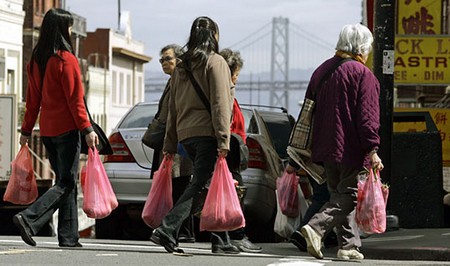
Ladies and their shopping http://www.economiesolidaire.com/wp-content/uploads/2008 / 01/chine-sac-plastique.jpg
Bio-Compostable Bag Bag http://www.airdeterre.com/images/pages/2008/09/sac_compostable . jpg
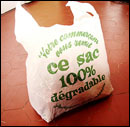
-biodegradable bag''This bag is 100% degradable'' http://www.dechetcom.com/infos/image/sac_fragmentable.jpg
-cotton reusable bag''Part of the solution'' http://www.ledetracteur.com/wp-content/telechargements/2009 / 12/sac-reutilisable.jpg
Sources:
Francoeur, LG. (2007). And if the good old plastic bags are more environmentally friendly? .
Taillefer, S. Gervais and , H. (2007). Reviews bags Shop for: evaluation of their environmental impact . www.recyc-quebec.gouv.qc.ca/client/fr/accueil.asp [Online]. ( http://www.recyc-quebec.gouv.qc.ca/Upload/Publications/MICI/Avis-SacsEmplettes-RQ-2007.pdf ) Accessed 2 July 2010.
CITY OF MONTREAL. Environment in Montreal: Solid Wastes . ville.montreal.qc.ca [Online]. ( ville.montreal.qc.ca / portal / page? _pageid = 916.3922488 & _dad = portal & _schema = PORTAL ) Accessed 2 July 2010.
[1] Taillefer, S. Gervais and , H. (2007). Reviews Shopping Bags: Environmental impact assessment . www.recyc-quebec.gouv.qc.ca/client/fr/accueil.asp [Online]. ( http://www.recyc-quebec.gouv.qc.ca/Upload/Publications/MICI/Avis-SacsEmplettes-RQ-2007.pdf ) Accessed 2 July 2010.




0 comments:
Post a Comment