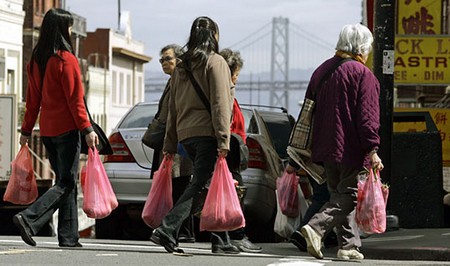
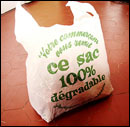
These "ladies" ... 
Bags Plastic is very present in our lives we use to make our purchases, to bring our lunches to work as a garbage can, etc.. However, the bags are also very present in the environment and this, with devastating consequences. In Quebec alone, Recyc-Québec estimates that approximately 2 billion plastic bags are distributed annually.
repercussions in the environment
Plastic bags begin to pollute their production as they are made from polyethylene, a derivative of oil. The changes made in refineries emit CO2 and plants require bags to be supplied with energy, and the vehicles that distribute the bags around the world.
Once used, they are sometimes recycled, which is still a better option than landfill. It is nonetheless that " e recycling of polyethylene (PE) remains limited: the relationship between weight and volume of PE makes the collection difficult and costly transport, the bags often have traces of other materials that have a negative effect on the quality of recycled and there are many kinds of PE in the market, which makes their separation difficult ".
Unfortunately, most of the time, the plastic bags end up in landfills or in the environment where they take 400 years to decompose. As it decomposes, toxic particles infiltrate their land, rivers and groundwater.

In water, the EP draws toxic hydrophobic particles such as PCBs and DDT ( contaminants toxic bioaccumulative Persistent ). Moreover, according to "Clean Up the Earth", a million seabirds, 100,000 sea mammals and countless fish each year die from asphyxiation or stocking following the ingestion of plastic bags they among others confuse with jellyfish and other foods. Worse, after they die, their carcasses decompose, but they have ingested the plastic is still intact and continues to cause the death of other animals.
Socio-economic

The slow decomposition of plastic bags ensure that landfills are filling up quickly; drainage systems can also be blocked, causing overflows leaching ("garbage juice", a highly toxic liquid) during heavy rainfall.
Visual pollution affects the quality of life and the image that tourists have of a place. Municipalities must also costs associated with cleaning of public spaces, thus the town of Leaf Rapids , Manitoba, is the first city in North America have banned the distribution of plastic bags. Many other cities and countries around the world took action by banning the distribution of plastic bags in shops:
- The 1 st June 2008, China prohibited the distribution of the plastic bags thinner and imposed a tax on other types.
- Taiwan tax plastic bags of all types.
- cities of Dhaka, Bangladesh and Mumbai, India, have banned them to prevent flooding due to blocked drainage systems during monsoon.
- thin plastic bags are banned since 2003 in South Africa, where they were once nicknamed "national flower", the thicker are taxed.
- Eritrea, Kenya, Somalia, Uganda and Rwanda have imposed similar measures.
- In 1994, Denmark has imposed a tax 22DK ($ 4.50) per kilo of plastic bags distributed by stores. This tax is paid by consumers indirectly.
- In 2002, Ireland imposed a tax of 15 euro cents on each plastic bag distributed in stores. The price is paid by the buyer. The number of bags distributed was reduced by 90% and the government received revenues of several million euros per year that are intended fund several environmental projects.
- The January 1, 2008, Huntington became the first city in Quebec to ban their use.
Alternative
Although plastic bags may seem to us indispensable, it is urgent that we change our habits to consume less. The solutions are simple, accessible and far-reaching!
First, you can buy cloth bags to do our shopping, whatever. Many shops are selling now and in all price ranges and styles. It is estimated that a reusable bag reduces our consumption of about 6 plastic bags per week, 24 per month and 288 per year!
For garbage, we can choose compostable bags that quickly decompose without contaminating soil, waterways and groundwater as they are made out of cornstarch or potato.
For more tips on all types of bags found on the market, check out our guide Plastic bags: how to find it? .
C Photo credits:
- plastic grocery bags http://an.capacadie.com/system/files/articles/51714/14a_sacs% 20.jpg
Turtle eating a plastic bag http://img101.imageshack.us/img101/2606/turtlexh6.jpg
-Bag plastic tree http://sandrominimo.blog.tdg.ch/media/00/01/1600825136.jpg
Sources:
Bagel by night (July 29, 2009). A little environmental consciousness: The great mass of plastic Pacific , The Bagel blog entry 29/07/209, http://lebagelblog.wordpress.com [Online]. ( http://lebagelblog.wordpress.com/2009/07/29/un-peu-de-conscience-environnementale-le-grand-amas-de-plastique-du-pacifique/ ) Accessed 12 July 2010.
ROACH, J. (2008). Plastic-Bag Bans Gaining Momentum Around the World , National Geographic edition of 04/04/2008 , http://news.nationalgeographic.com [Online] . ( http://news.nationalgeographic.com/news/2008/04/080404-plastic-bags.html ) Accessed July 13, 2010.
John Abbott College Activists (2008). Project ban plastic bags in Sainte-Anne-de-Bellevue , http://www.aqpere.qc.ca [Online]. www.aqpere.qc.ca/ ... projects / BAGS % 20EN% 20 PLASTIC . pdf
Taillefer, S. Gervais and , H. (2007). Reviews Shopping Bags: assessment of their environmental impact . www.recyc-quebec.gouv.qc.ca/client/fr/accueil.asp [Online]. ( http://www.recyc-quebec.gouv.qc.ca/Upload/Publications/MICI/Avis-SacsEmplettes-RQ-2007.pdf ) Accessed 2 July 2010.
Commission for Environmental Cooperation of North America. DDT is no longer used in North America , http://www.cec.org [Online]. http://www.cec.org/Storage/50/4286_DDT_fr.pdf
Commission for Environmental Cooperation of North America. Polychlorinated Biphenyls , http://www.cec.org [Online]. http://www.cec.org/Storage/50/4301_PCBs_fr.pdf